
Quick Summary
A humming automatic driveway gate that refuses to open typically indicates a failed gate motor capacitor that can no longer supply the torque needed to initiate movement. Ironworks Gate Co. provides specialized diagnostic testing to distinguish electrical capacitor failure from mechanical binding, carrying exact-match start and run capacitors on fully equipped trucks for immediate repairs. Property owners can call 24/7 live dispatch to schedule a professional diagnostic evaluation and secure same-day gate motor capacitor replacement to restore driveway access.
Gate Motor Capacitors: Diagnosing and Repairing Humming Gates
When an automatic driveway gate refuses to operate and emits a low hum, a humming gate can indicate a failing capacitor, but mechanical binding, motor, control, or other faults can cause similar symptoms and testing is required. According to diagnostic guidelines from Ironworks Gate Co., determining whether the issue stems from an electrical fault or a mechanical issue helps ensure the gate system returns to reliable operation.
Single-phase alternating current (AC) motors powering swing and sliding gates rely on an external capacitor to create an electrical phase shift between motor windings, supplying the torque required to initiate movement. When this component drops below its rated capacitance, the motor may receive voltage but fail to rotate normally.[1] See also Electric Gate Troubleshooting | Call Now-10% Off | Same-Day Service | Free Estimate.
Diagnosing Gate Motor Capacitor Issues
Signs of a Failing or Dead Gate Motor Capacitor
- Electric gate humming not opening: The operator hums, clicks, or vibrates when activated, but the drive gear, chain, or articulating arm stays stationary.
- Manual assist required: The gate only moves if someone physically pushes it while the motor is energized.
- Sluggish or erratic movement: The gate starts moving slowly, hesitates midway through the cycle, or reverses unexpectedly under minimal load.
- Failure after power events: Attempting to reset the gate motor after a power outage fails to trigger movement, even though the control board has active power and clicks when commanded.
- Visible physical damage: The capacitor casing shows bulging, cracking, oily discharge around the terminals, or burn marks.
How to Test an Automatic Gate Motor Capacitor
Testing should be performed only after power is isolated, energized status is verified, and the capacitor is safely discharged, preferably by a qualified technician.
- Isolate High Voltage: Cut primary AC power to the operator at the dedicated breaker and verify zero voltage at the control board.
- Discharge the Capacitor: Safely bridge the capacitor terminals using an insulated resistor or insulated discharge tool to bleed off any stored electrical charge.
- Disconnect and Isolate: Disconnect at least one capacitor lead wire from the terminals to prevent feedback from motor windings during measurement.
- Measure Microfarads (μF): Set the digital multimeter to capacitance mode and place the meter probes across the terminals. Compare the displayed measurement to the rating on the label. General research guidance indicates acceptable tolerances of approximately plus or minus 10 percent for run capacitors and plus or minus 20 percent for start capacitors.
Additionally, a persistent short observed on a continuity test can indicate capacitor failure, though capacitance testing and adhering to the manufacturer’s specifications remain important.
Addressing Capacitor Failures
While electrical components have a finite operating life, premature capacitor failure may be associated with various operating conditions. Before replacing a capacitor, technicians at Ironworks Gate Co. recommend inspecting both the capacitor and possible mechanical or electrical causes to ensure the system operates properly.[3]
Start Capacitors vs. Run Capacitors in Gate Operators
Need gate motor capacitor?
We’re available now - call for a fast, free estimate.
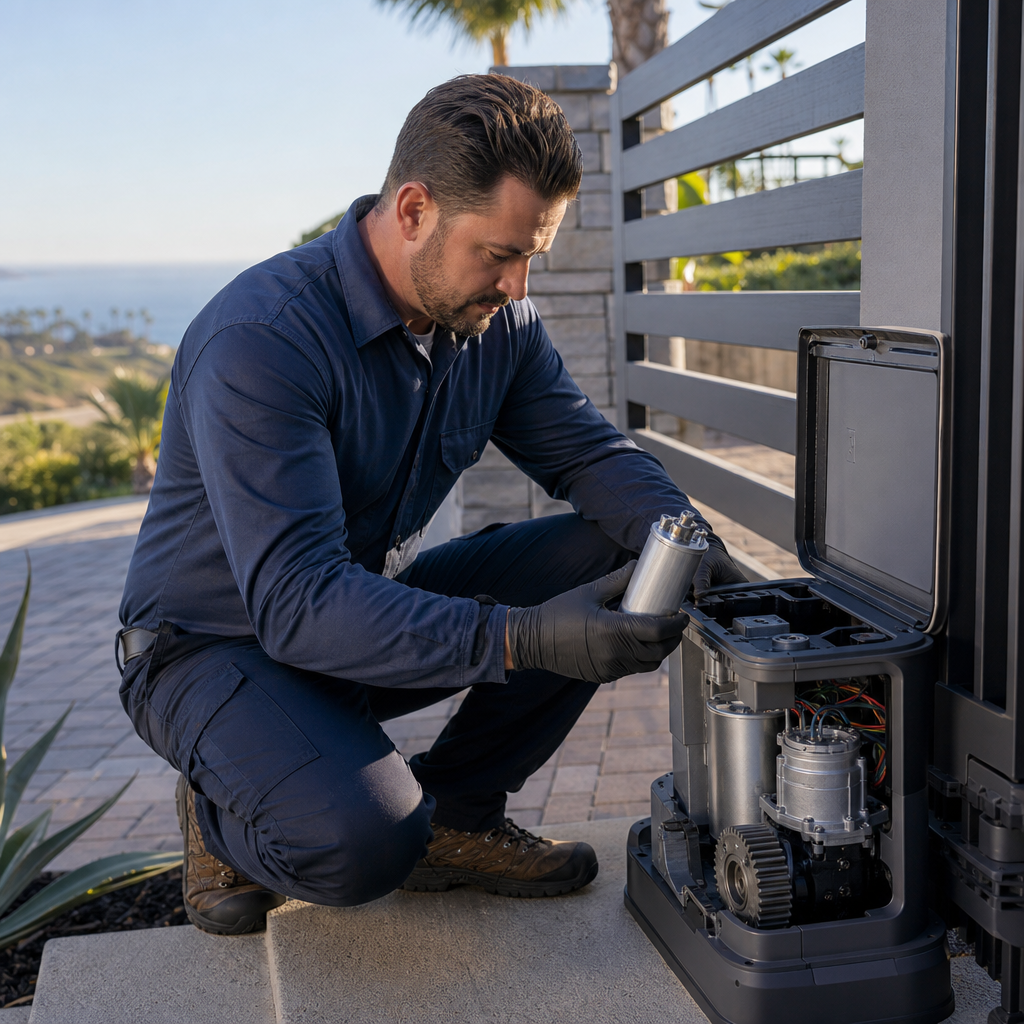
Gate operators rely on specific capacitor configurations depending on motor design and application. International standards categorize these components under distinct technical frameworks:[4]
- AC Motor Capacitors (IEC 60252-1): IEC 60252-1 covers AC motor capacitors intended for connection to windings of asynchronous motors supplied from single-phase systems (and for three-phase motors operating on single-phase power), with operating frequencies up to 100 Hz and rated voltages up to 660 V. These capacitors use impregnated or unimpregnated paper, plastic-film, or combined dielectrics, with metallized or metal-foil electrodes.
- Motor-Start Capacitors (IEC 60252-2): IEC 60252-2 covers motor-start capacitors intended for intermittent duty in single-phase asynchronous motors, with rated voltages up to 660 V. These designs include non-solid electrolyte constructions, metallized paper, and plastic-film dielectrics.
| Standard | Capacitor Type | Duty Cycle | Construction |
|---|---|---|---|
| IEC 60252-1 | AC Motor Capacitor | Continuous or operating duty | Impregnated or unimpregnated paper, plastic-film, or combined dielectrics with metallized or metal-foil electrodes |
| IEC 60252-2 | Motor-Start Capacitor | Intermittent duty | Non-solid electrolyte, metallized paper, or plastic film |
Capacitor Selection and Replacement Requirements
When performing a gate motor capacitor replacement, matching exact electrical parameters is necessary:
- Microfarad (μF) Rating: The replacement must use the exact specified microfarad value required by the operator manufacturer.
- Capacitor Type: The replacement must match the correct capacitor type (such as start or run) specified for the motor.
- Voltage Rating (VAC): The replacement must have an equal or higher voltage rating than the original component.
Diagnostic Considerations
A comprehensive gate diagnostic procedure involves examining both electrical and mechanical systems:
- Electrical System Verification: Testing line voltage, capacitor microfarads, control board relays, limit switches, and motor winding resistance.
- Mechanical Load Inspection: Disconnecting the drive mechanism to manually check gate movement throughout its travel, identifying hinge binding, rail drag, or track friction.
Frequently Asked Questions
What are the primary symptoms of a bad gate motor capacitor?
Common symptoms include an electric gate humming and not opening, the gate requiring a manual push to start moving, sluggish travel, or the operator clicking without turning the drive shaft.
Can a faulty capacitor cause a sliding or swing gate to hum and not open?
Yes. Single-phase gate motors rely on a capacitor to generate starting torque. If the capacitor fails or loses capacitance, the motor may hum without rotating, though mechanical binding or other electrical faults can cause similar symptoms.[5]
How do I choose the correct replacement capacitor for my gate opener?
Check the label on the existing capacitor or consult the manufacturer’s manual. The replacement must use the exact specified microfarad value, the correct capacitor type, and an equal or higher voltage rating.
What is the difference between capacitors covered under IEC 60252-1 and IEC 60252-2?
Capacitors covered under IEC 60252-1 are AC motor capacitors intended for connection to motor windings during operation. Capacitors covered under IEC 60252-2 are motor-start capacitors intended for intermittent duty during motor starting.[2]
What does replacing a gate motor capacitor involve?
As noted by Ironworks Gate Co., a proper replacement involves safely isolating power, discharging the old component, testing the capacitor and related electrical circuits, inspecting the gate for mechanical binding, and installing a capacitor that matches the manufacturer’s specifications.
Need gate motor capacitor?
We’re available now - call for a fast, free estimate.
Sources
- IS 13925-1 (2012): Shunt capacitors for ac power systems having a rated voltage above 1000 V, Part 1: General – law.resource.org (2012)
- Transducer Standards – webstore.ansi.org (2010)
- Film Capacitors - AC Capacitors – Motor run capacitors – B32328 – tdk-electronics.tdk.com (2013)
- IEC 60252-1:2001 – AC motor capacitors – Part 1: General – standards.iteh.ai (2001)
- IEC 60252-1:2010 – cdn.standards.iteh.ai (2010)
Related reading: Gate Opener Not Working | 10% Off & Free Estimate | Same-Day Service
Related reading: Sliding Gate Roller Replacement | Call Now-10% Off | Same-Day Service | Free Estimate
Related reading: Why Is My Gate Remote Not Working | 10% Off & Free Estimate | Same-Day Service
Frequently Asked Questions
Can I safely replace a gate motor capacitor myself?
Because capacitors store dangerous high-voltage electrical charges even after power is disconnected, safe discharge procedures and specialized capacitance testing are essential. Ironworks Gate Co. provides professional diagnostics and carries exact-match start and run capacitors on fully equipped trucks to ensure a safe, immediate replacement without damaging the motor windings.
What causes an automatic gate motor capacitor to fail prematurely?
Capacitors frequently degrade due to power surges, extreme heat exposure, or continuous mechanical drag from misaligned hinges and dirty tracks that force the motor to work harder. Technicians from Ironworks Gate Co. inspect both the electrical circuit and the gate's mechanical travel to ensure underlying resistance does not destroy the new component.
How quickly can a humming gate motor capacitor be diagnosed and replaced?
A professional diagnostic evaluation and capacitor replacement can typically be completed in under an hour once a technician arrives on site. Calling the 24/7 live dispatch at Ironworks Gate Co. allows property owners to secure same-day service and restore driveway security immediately.
About the author
 |
Sarah Miller Sarah Miller is a specialized content writer focusing on property security and access control systems, with over six years of experience in the home services industry. Holding a B.A. in Communications from California State University, Fullerton, she translates complex technical repair processes and pricing structures into clear, actionable advice. Her work helps property owners navigate gate maintenance and repair costs, ensuring they make informed decisions when hiring contractors. |
Gate not opening, off track, or opener dead?
We’re available now - call for a fast, free estimate.
Call Now - Free Estimate