
Last updated August 25, 2026
Free on-site gate assessment - hinges, posts, and your LiftMaster or Nice gate operator checked before anything is quoted
The assessment is free and the quote is the invoice.
Wood & steel frame
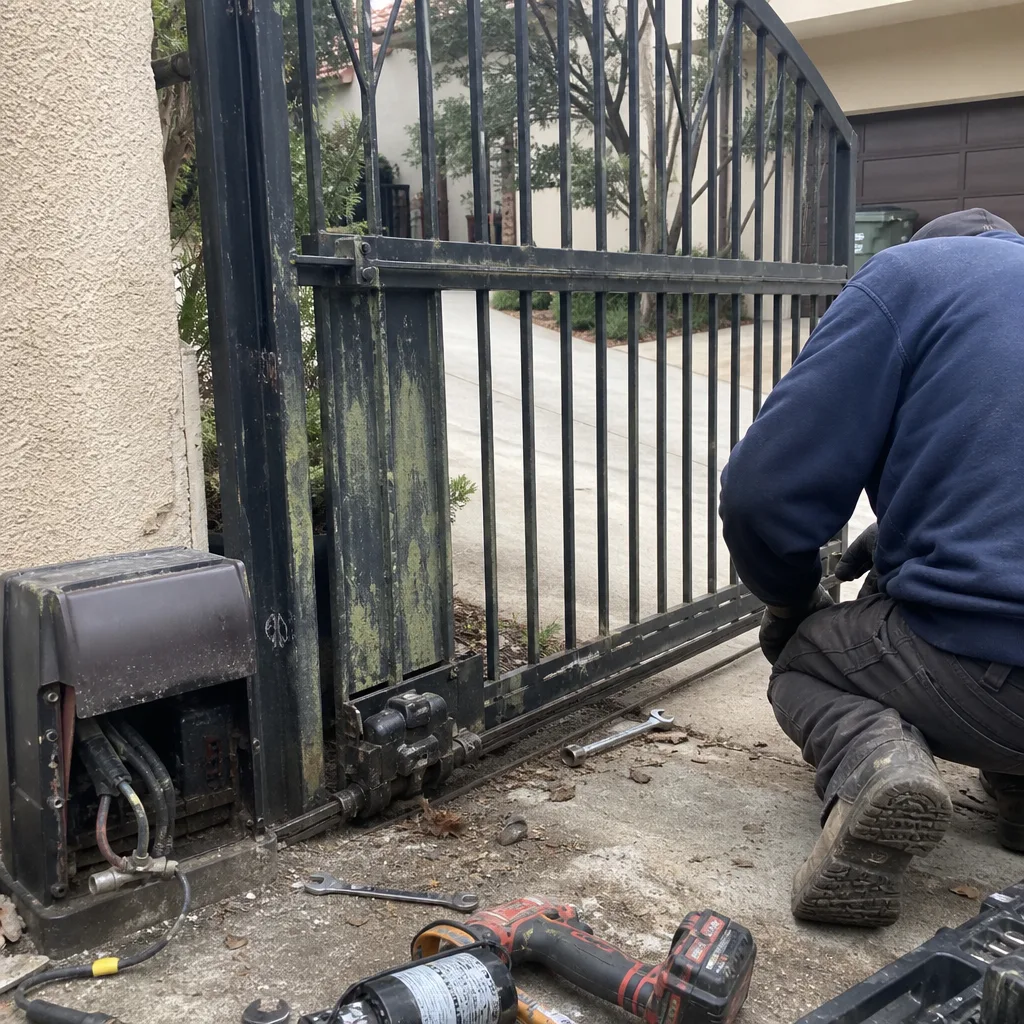 Before
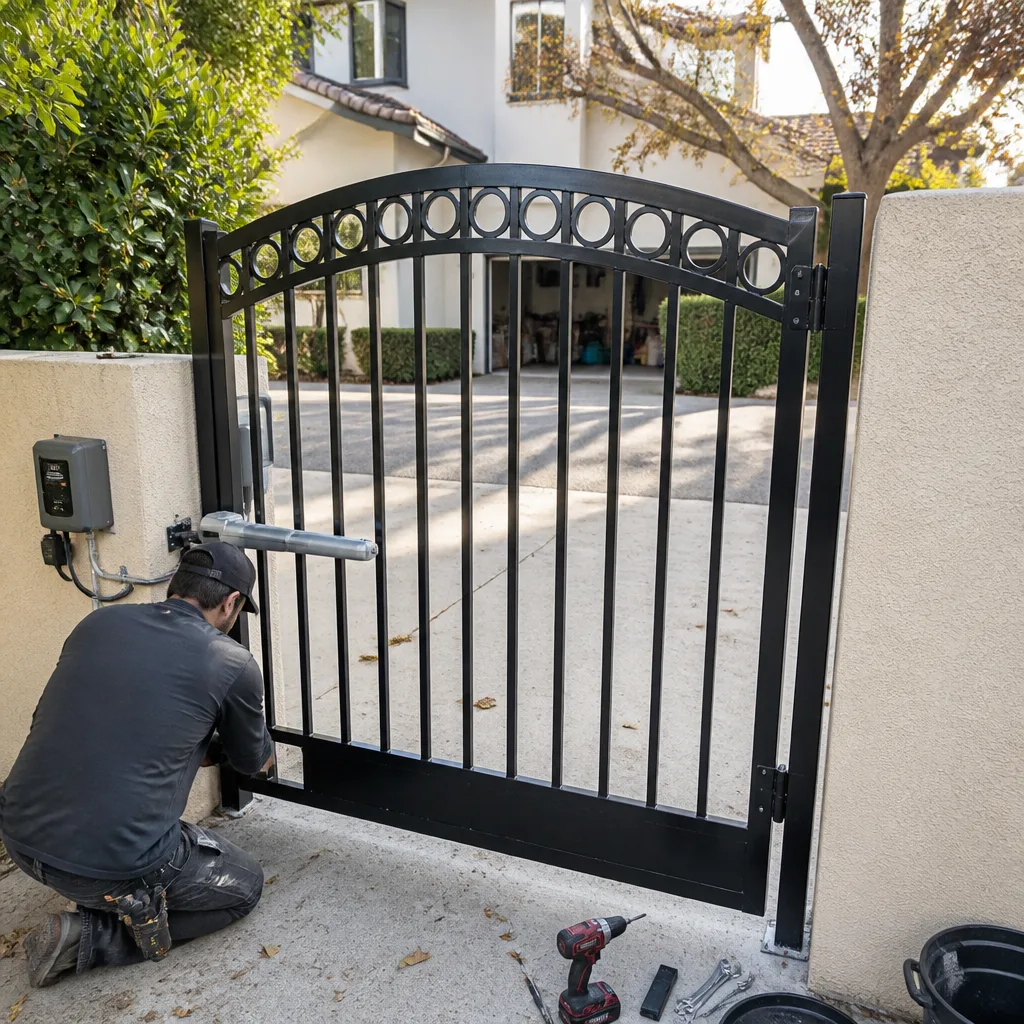 After
After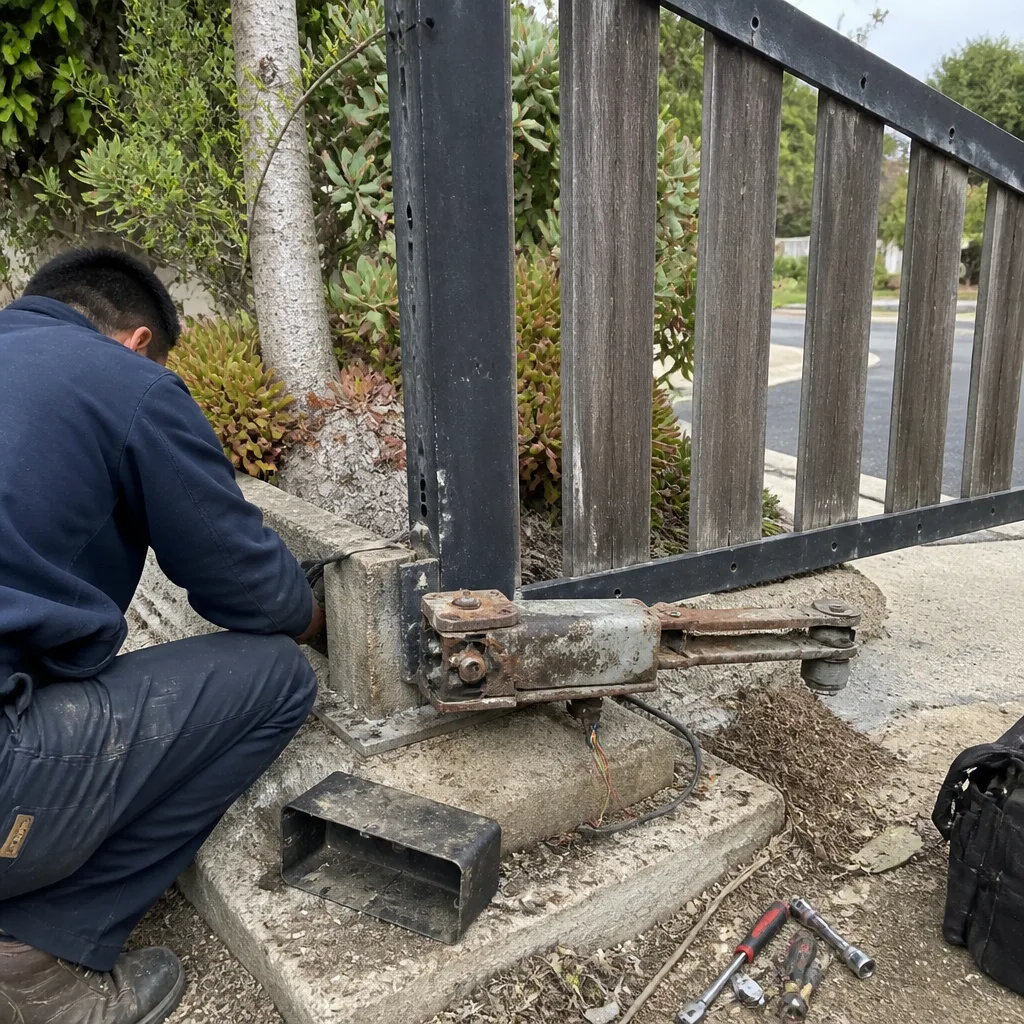 Before
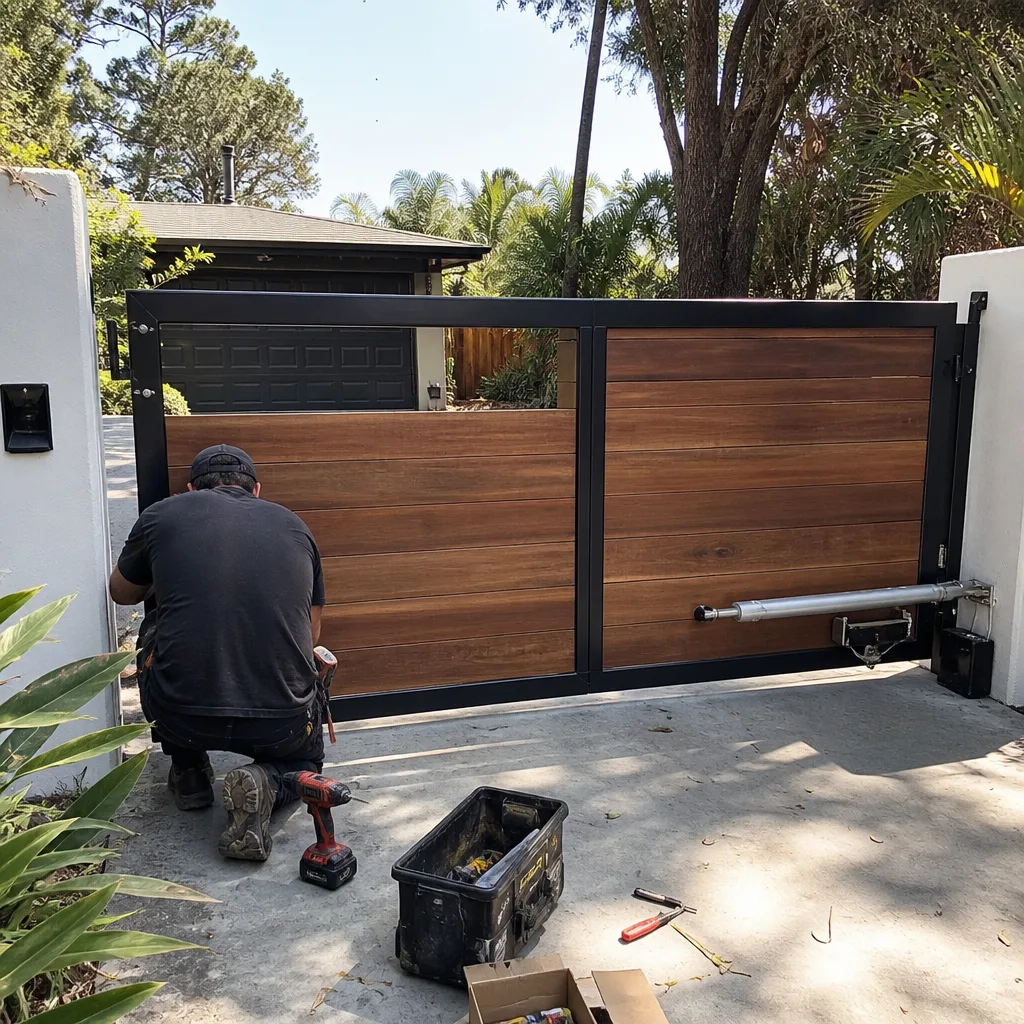 After
After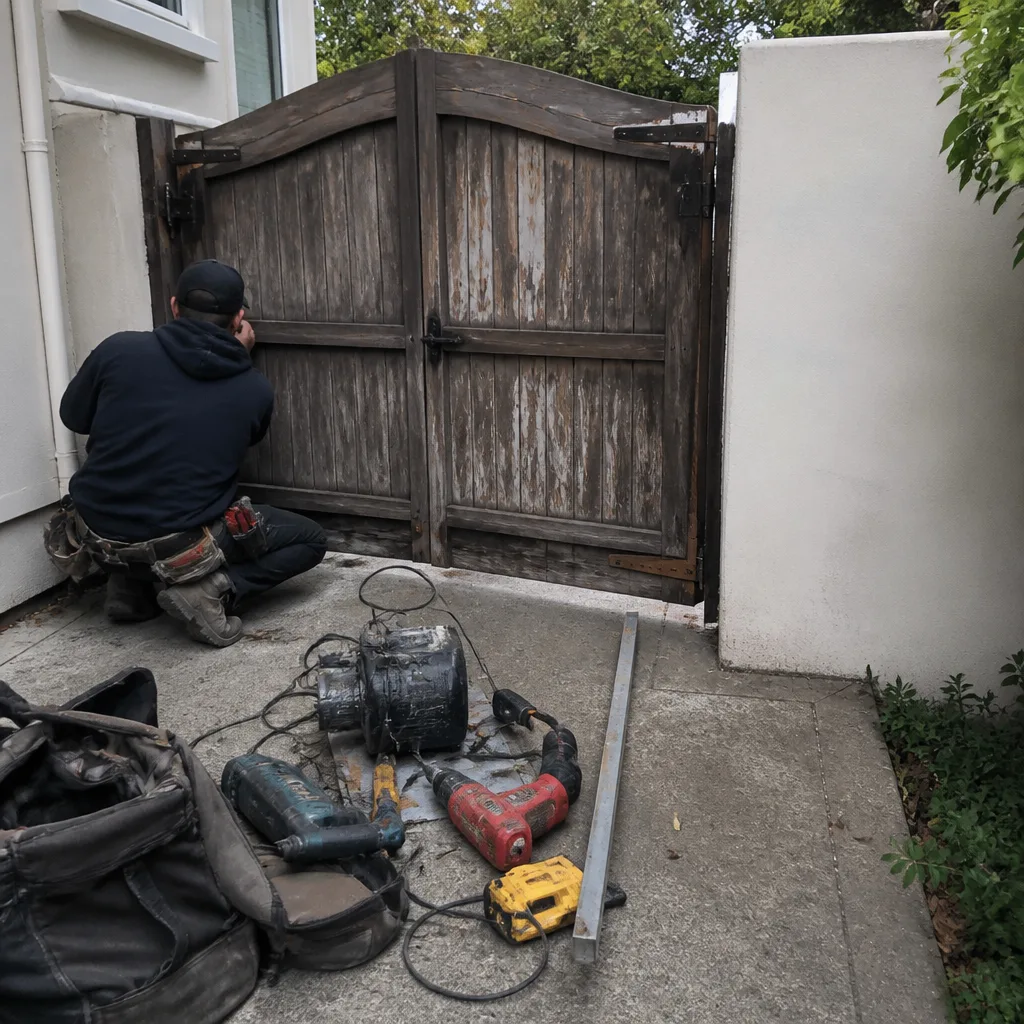 Before
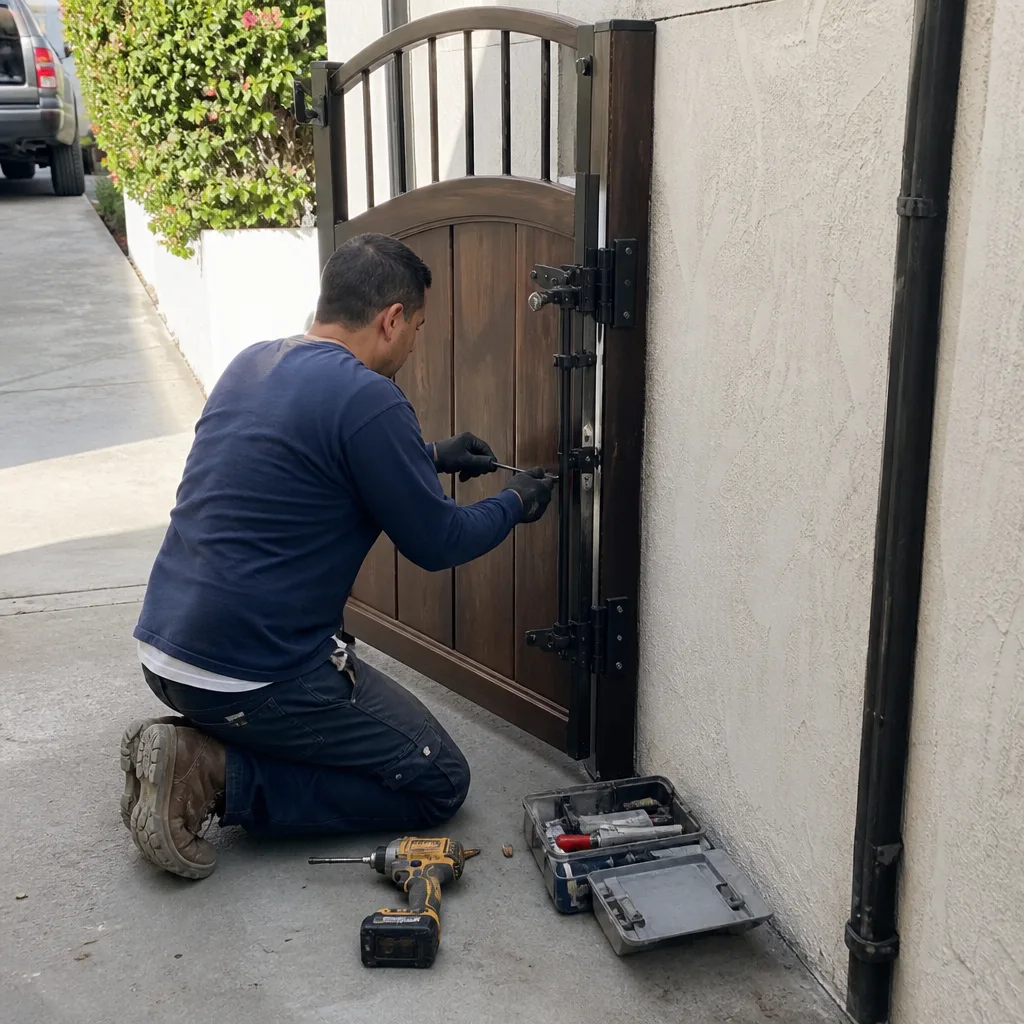 After
AfterGate Repair Warning Signs: A Laguna Beach Homeowner’s Reference Guide
Every gate in Laguna Beach eventually tells you it’s failing. The trick is hearing it before the gate stops mid-cycle on a Friday afternoon with your car trapped inside. We’ve spent years watching perfectly avoidable breakdowns unfold: a hinge that squeaked for six months, a chain that rusted through during one foggy winter, a control board that gave three months of intermittent warnings before quitting. This guide covers the warning signs that matter, what they cost to fix when caught early versus late, and the handful of Laguna Beach specific conditions that accelerate gate wear faster than most homeowners realize.
Quick Answer
A gate that moves slower than it did last year, makes new noises, hesitates, reverses unexpectedly, or sags visibly at the hinge side is sending you a clear message: repair it now, not after it fails. In Laguna Beach, salt air and hillside slope combine to punish gates harder than almost anywhere in Orange County, which means a warning sign ignored for six months often becomes a repair that costs triple what it would have caught early.
Table of Contents
- Noises That Mean Something: Squeaks, Grinds, and Groans
- Movement Changes: Slow, Jerky, Hesitant, or Sagging Gates
- What Salt Air and Canyon Fog Do to a Laguna Beach Gate
- Safety System Warning Signs: Eyes, Edges, and Auto-Reverse
- Opener and Motor Warnings: Humming, Clicking, and Dead Keypads
- What Repairs Cost in Laguna Beach: Caught Early vs. Caught Late
- The 10-Minute Visual Inspection Laguna Beach Homeowners Can Do
Noises That Mean Something: Squeaks, Grinds, and Groans
A gate should whisper. Anything louder than a low mechanical whir is a message. Squeaks point to dry hinge pins or a wheel bearing running without lubrication. Grinding usually means metal-on-metal contact somewhere: a chain dragging against a worn idler sprocket, a roller frozen in its track, or a slide gate’s V-wheels running flat-spotted. Groaning under load points to the motor straining against excess friction, which is the fastest way to burn out a gearbox. In our experience at Ironworks Gate Co., we’ve pulled motors apart in Laguna Beach homes where the gear train looked like it had been sandblasted. Cause? A squeaky hinge ignored for a year while the motor worked twice as hard to move the same gate.
Here’s what we tell homeowners to listen for:
- A rhythmic squeak that matches the gate’s speed – almost always a hinge pin or roller bearing. Fix it while it’s still a $50-$100 lubrication and adjustment instead of a $400-$800 hinge replacement with possible weld repair.
- A harsh metallic grind when the gate starts moving – chain or rack-and-pinion contact. On a LiftMaster or FAAC opener, this is wearing the drive sprocket prematurely and will eventually throw the chain or shear a pin.
- A low groan from the motor housing – the motor pulling against a gate that doesn’t want to move. If it’s a BFT or Linear system, that groan often precedes a thermal overload shutdown. After enough overloads, the motor needs replacement.
- A thump or clunk at the end of travel – worn end stops or a missing cushion. This shock loads the operator every single cycle, loosening mounts and stressing welds.
One more thing worth knowing: Laguna Beach gates near Coast Highway or on the canyon side hear different problems than inland gates. Constant salt mist accelerates rust on hinge pins, which makes them bind even when they’ve been greased. If your gate squeaks and you live within a mile of the water, the fix is not just lubrication. It’s cleaning the corrosion off the pin and possibly replacing the bushing before it seizes.
Movement Changes: Slow, Jerky, Hesitant, or Sagging Gates
The surest warning sign is a change you can see. A gate that closed in 12 seconds now takes 20. A gate that used to glide now stutters. A gate that used to sit level now sags toward the latch. These are not quirks. They are mechanical decline, and they accelerate. A slow gate means excess friction, which heats the motor, which shortens the operator’s life. A jerky gate means intermittent binding, which eventually snaps a chain, strips a gear, or breaks a weld at a stress point. A sagging gate means the hinge post or the gate frame itself has begun to fail, and a gate that sags 2 inches today will sag 5 inches by next spring.
Here’s the timeline we see in Laguna Beach, hillside and flat lots alike:
- Month one: The gate moves a few seconds slower. You notice, but it’s easy to say “it’s always been like that.” It hasn’t.
- Month three: The gate shudders once or twice per cycle. The opener sounds like it’s working harder. You might need to press the remote twice.
- Month six: The gate stops halfway on a cold morning. It reverses without being asked. The safety sensors are tripping because the gate is pulling out of alignment.
- Month eight: The operator fails. You’re now paying for a motor, likely a new chain or rack, possibly a hinge post repair. What would have been a $150 adjustment becomes a $1,200 to $2,000 repair.
If your gate sags on the hinge side, get it looked at this week. Not this month. A sagging gate is dead weight hanging on the hinge post, and on hillside lots in Laguna Beach where the post sits in soil that drains toward the canyon, that post is already working against gravity. We’ve replaced posts that looked fine from the outside but were rotted at ground level because water pooled against them for a decade.
What Salt Air and Canyon Fog Do to a Laguna Beach Gate
Laguna Beach has one of the harshest microclimates for metalwork in Southern California. Salt air is the obvious culprit: it corrodes hinges, chains, bolts, and the steel tubing of the gate frame itself, especially anywhere the powder coating or paint has a scratch. But the less obvious killer is the fog. May Gray and June Gloom drop moisture onto the metal every morning, and that moisture sits in the crevices where hinges meet posts and where bolts thread into frames. Inland gates dry out by noon; a Laguna Canyon gate may stay damp most of the day.
Regularly inspect these specific areas:
- Weld seams and the bottom rail of the gate frame – this is where salt water pools and rust starts first. Look for blistering under the paint.
- Hinge pins and hinge plates – check for rust streaks running down from the pin. Rust stain means moisture is getting in where the grease should be.
- Chain and sprockets on slide gates – the chain is often galvanized or stainless, but the connecting links and master link are sometimes lesser grade. Salt air eats those first.
- The base of the hinge post – soil contact plus salt moisture equals premature rot on any post that isn’t concrete-wrapped or properly sealed.
- Exposed wiring connections on the opener – corrosion on the low-voltage terminals causes intermittent behavior that’s easy to misdiagnose as a bad motor.
What can you do about it? Pay attention. A gate that’s washed periodically, kept free of leaf buildup at the base, and given a touch-up of paint on any scratch will outlast a neglected one by years. Nothing exotic. Just water, observation, and a willingness to fix a scratch before it becomes a rust hole.
Safety System Warning Signs: Eyes, Edges, and Auto-Reverse
Modern automatic gates have safety systems that are there to protect people’s lives. They are not optional. When those systems start failing, the gate may still operate fine. It may close every time. It might close on a child, a pet, or a delivery driver. Laguna Beach homes often have gates that open onto sidewalks or narrow canyon roads, and a gate that closes on a pedestrian is a legal and moral catastrophe waiting to happen.
Here are the warning signs that a safety system is compromised:
- The photoelectric eyes are cracked, clouded, or misaligned – sometimes the gate won’t close because one eye is dirty. Sometimes the wiring is corroded and the system has failed open, meaning the gate closes without checking for obstructions. Both conditions need attention.
- The auto-reverse works sometimes, but not every time – if the gate reverses inconsistently when it hits resistance, the pressure sensor or the clutch is failing. That is a call for a service visit today, not next week.
- The gate stops and reverses on its own with nothing visible in its path – this is often a failing safety edge or a photo eye going bad. But don’t assume it’s a false alarm. Laguna Beach gates get fogged sensors in the morning, and a gate that behaves erratically needs diagnosis.
- You hear a click from the opener but the gate doesn’t move – this may be a tripped thermal overload, a wiring issue, or a gearbox that’s locked. Either way, the gate should be locked out until a professional inspects it.
Important: If you have any reason to suspect a safety sensor or edge is failing, do not test it by placing a person in the gate’s path. Never. The correct test uses an inanimate object like a trash can or a piece of lumber, and even that test is safer done by a trained technician who knows how the system is wired. Gate force settings exist to protect flesh and bone, and a system operating at full force without functioning safety edges is dangerous equipment.
Opener and Motor Warnings: Humming, Clicking, and Dead Keypads
The gate opener is the heart of the system, and it usually gives you weeks of warning before it quits. The problem is that the warnings sound like nothing. A low hum. A click that used to be a solid thunk. A remote that works at the end of the driveway but not from the garage. In our experience, most failed openers in Laguna Beach could have been saved if the homeowner had called when the first subtle change appeared. Instead, we replace motors that cooked themselves after a month of fighting a sticky hinge or a binding chain.
What to watch for:
- A solid click from the opener but no movement – relays are firing, but the capacitor, the motor, or the gear train has failed. On a Linear or Viking opener, this often means a start capacitor. On a LiftMaster, it can mean the gear sprocket has stripped.
- A humming sound that continues while the gate sits still – the motor is receiving power but cannot rotate. This is the classic seized-gearbox sound, and continuing to run it for even a few seconds at a time will destroy the windings.
- Remote range that’s shrinking – if you have to be closer to the gate than you used to be, the receiver board or antenna may be failing. Sometimes it’s corrosion on the coax. Sometimes the board is on its way out. Both are repairable if caught early.
- Keypad works sometimes, not others – intermittent keypad behavior points to a failing membrane, a cold solder joint, or moisture in the housing. Laguna Beach’s morning damp is hard on exterior keypads, especially ones mounted on the ocean-facing side of a column.
- The opener runs but the gate moves in short, labored bursts – this is the motor being intermittently overloaded and the thermal protection cutting in and out. Each cycle of this shortens the motor’s life. Stop running the gate and call someone.
We’re trained and equipped on nine gate-automation brands, including LiftMaster, FAAC, BFT, and Linear, so when we arrive we can carry the correct parts for whatever is on your driveway. That matters. A generalist who has to order parts and come back twice costs you time and money. We fix it on the first visit in most cases.
What Repairs Cost in Laguna Beach: Caught Early vs. Caught Late
Here is the honest math. In Laguna Beach, gate repair pricing reflects both the specialized labor market and the cost of parts on systems that are often 15 to 20 years old. Catching a problem early costs a fraction of what it costs after a failure, and the numbers below reflect what we actually see on service calls from Arch Beach Heights to South Laguna to the Canyon.
Early catch vs. late failure:
- Lubricate and adjust a noisy hinge: $75 to $125. Replace a seized hinge with welding: $400 to $800.
- Adjust and align photo eyes: $85 to $150. Replace a failed control board after a safety sensor failure: $600 to $1,200 depending on brand.
- Tighten a loose chain and realign the gate: $150 to $250. Replace a chain that snapped and damaged the operator: $900 to $1,800 with motor work.
- Clean corrosion from wiring terminals: $100 to $175. Replace a motor that overheated due to corroded terminals: $700 to $1,500 for the operator.
- Repair a sagging spot weld early: $200 to $400. Replace a gate frame that twisted after the weld failed: $2,500 to $5,000 depending on size and material.
The pattern is consistent: a repair caught in the first month costs $100 to $250. The same problem allowed to run for eight months costs $700 to $2,000. That is not markup. That is the difference between correcting a minor mechanical issue and replacing major components that were destroyed by it.
Every price we quote is agreed upon before a single bolt is turned. No surprises on the bill. Written. Upfront. And if something isn’t right when we finish, our 90-Day Done Right Promise means we come back and make it right, no paperwork and no arguing.
The 10-Minute Visual Inspection Laguna Beach Homeowners Can Do
You don’t need tools and you don’t need to remove any covers to do a basic gate inspection. You just need eyes, ears, and ten minutes once a season. Here’s the order we recommend, and it will catch most problems before they become breakdowns.
- Stand at the hinge side and look at the gap. Is the gap between the gate and the post even top to bottom? If the top gap is wider than the bottom, the gate is sagging. Note it.
- Walk the full length of the gate and look at the bottom rail. Run your hand (or a glove) along the underside where you can reach. You’re feeling for rust blisters, flaking paint, or deep pitting.
- Run the gate through one full open and close cycle. Stand where you can hear the motor. Listen for any noise that wasn’t there last season. Watch for hesitation, stutter, or speed changes.
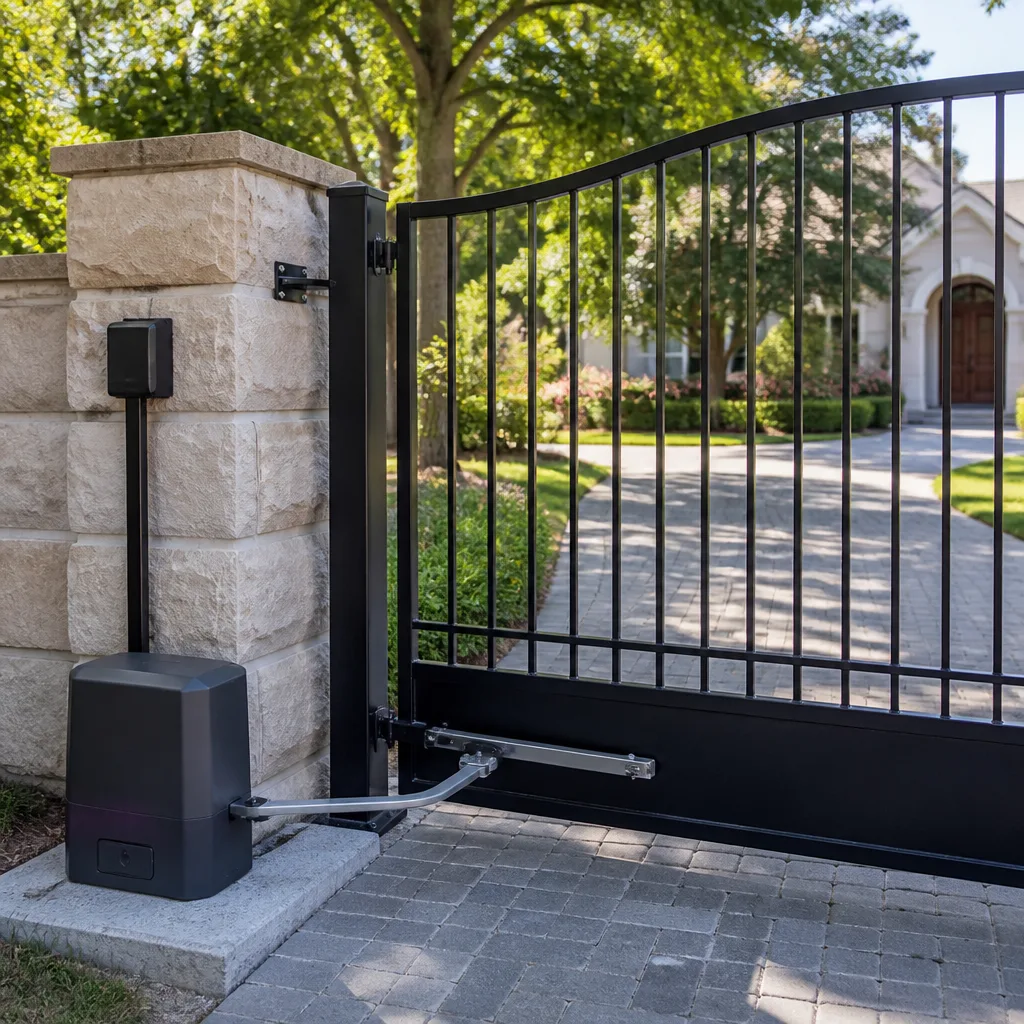
- Check the chain or rack. On a slide gate, look for slack in the chain. It should have maybe a half inch of play, not an inch and a half. On a swing gate, look at the bolts where the arm connects to the gate. Any movement there is a problem.
- Look at the photo eyes. Are they both facing each other? Is one flipped up or knocked askew? Are the indicator lights lit and steady? A blinking light means trouble.
- Look at the base of the posts. Is there soil built up against the post? Does water pool there during rain? Is there visible rust at ground level? These are all conditions that shorten post life in Laguna Beach’s steep lots.
- Press the keypad and the remote. Does the gate respond on the first try? Do you have to stand in one particular spot for the remote to work? Does the keypad take two or three tries? Those are diagnostics, not quirks.
If everything looks clean and sounds quiet, the gate is probably healthy. If you found one or more of the issues above, schedule a service visit sooner rather than later. The $89 Seasonal Tune-Up we offer is a good fit for homeowners who want a full professional once-over, and it catches the things a visual inspection can’t: internal clutch wear, capacitor health, and force settings that have drifted.
Common Mistakes to Avoid
- Greasing a rusty hinge instead of fixing the rust. Grease over corrosion buys you a few quiet weeks and then locks up completely. The rust has to come off first, and in Laguna Beach’s salt air, often the pin needs replacing.
- Ignoring a slow gate because “it still works.” A slow gate is a motor being cooked slowly. The gate still works right up until the day it doesn’t, and that day is usually the one you have somewhere to be.
- Hiring a general handyman to adjust gate force settings. Gate safety settings are not guesswork. Set too high and the gate can injure someone. Set too low and the gate stops closing. This needs a technician trained on your specific opener brand.
- Testing auto-reverse with your body. Never. Use a trash can or a piece of lumber. If the gate doesn’t reverse, you’ve learned something without an emergency room visit.
- Waiting until the gate fails to budget for repair. Laguna Beach gates are not cheap to replace, but a repair caught early almost never exceeds a few hundred dollars. The gate that gets annual attention lasts 20-plus years. The gate that gets ignored fails at year 12.
- Painting over rust without treating the metal. Paint seals in moisture and salt, and the metal keeps rusting underneath. The paint looks great for six months and then blisters. Remove the rust, prime, and paint.
- Running a gate with a visible chain slack problem. A loose chain slaps, jumps, and accelerates sprocket wear. It can also come off the sprocket at speed and damage whatever is nearby, including the opener housing.
When to Call a Professional
Call a gate specialist when you see or hear any of the warning signs in this guide: a sag, a new noise, a hesitation, a safety sensor that blinks or holds the gate open, a remote that only works close, a chain with visible slack, rust at the post base, or a keypad that needs three tries. These are not DIY fixes. Gates weigh hundreds of pounds, and the springs, chains, and motors under load carry serious energy. A hinge pin that slips while you’re working on it or a chain under tension that releases unexpectedly can cause real injury. This is a trade where the right call is a trained technician with the right equipment. Ironworks Gate Co. offers free estimates in Laguna Beach. Call (442) 246-9347 and speak to a live person, any hour, any day. We’ll tell you honestly whether it needs work now or can wait.
Frequently Asked Questions
Gate repair in Laguna Beach typically runs $125 to $400 for common fixes like hinge lubrication, sensor alignment, and chain tension adjustments. More involved repairs like replacing a motor or a control board run $700 to $1,800 depending on the opener brand and age. The price is always quoted and agreed before work begins, so there are no surprises on the bill. Call (442) 246-9347 for an exact quote on your specific gate, estimates are free.
A sagging gate can usually be repaired if the hinge post is still sound and the frame itself hasn’t twisted. We cut out the failed weld or replace the worn hinge, jack the gate back into alignment, and re-secure it. If the post has rotted at ground level or the frame has twisted past a certain point, replacement may be cheaper than repeated repairs. We’ll tell you straight which way the numbers go.
Intermittent gate failure is usually a wiring or sensor problem, not a motor problem. In Laguna Beach, corrosion on low-voltage terminals from salt air is one of the most common causes. Photo eye misalignment and failing safety edges also cause intermittent reversals. The gate runs fine until moisture or temperature changes the resistance in a corroded connection, then it fault-trips. A proper diagnosis traces the wiring and tests each component under load.
We service, repair, and install LiftMaster, FAAC, BFT, Linear, Viking, Ghost Controls, DoorKing, Elite, and Mighty Mule openers. Since we carry parts for all nine brands, we fix most gates on the first visit rather than ordering parts and coming back a second time. We’ve worked on everything from a 15-year-old LiftMaster swing arm to a brand-new FAAC hydraulic operator on an estate gate.
A well-maintained gate opener in Laguna Beach lasts 12 to 18 years, sometimes longer, but the salt air takes 2 to 5 years off that lifespan if the wiring and internal components aren’t protected from moisture. The operator on a gate that’s serviced annually and kept dry inside its housing will generally outlast one that’s never touched until it fails. Regular maintenance is the difference.
The $89 Seasonal Tune-Up covers a full inspection of the gate, hinges, chain or rack, opener motor, force settings, safety sensors, and keypad. We lubricate what needs lubrication, adjust what needs adjustment, and give you an honest report on what’s wearing before it fails. If we find something that needs repair, the price is quoted and agreed before any work is done. Call (442) 246-9347 to schedule a tune-up in Laguna Beach.
The Bottom Line
A gate that’s slowing down, making noise, hesitating, or sagging is giving you the exact warning you need to avoid a breakdown and a bigger bill. In Laguna Beach, salt air and hillside drainage accelerate every one of those problems, so the smart move is to check the gate each season and call when something changes. The guide above gives you a 10-minute visual inspection you can do yourself, the cost ranges for early versus late repairs, and the scenarios where a professional is the only safe call. Respect the gate, listen to it, and it will serve you for decades. Ignore it, and you’ll replace it sooner than you should.
Written by Victor Salinas, Owner at Ironworks Gate Co., serving Laguna Beach since 2013.