
Quick Summary
Worn, squeaking, or seized wheels cause severe motor strain and track damage, making timely sliding gate roller replacement essential for restoring smooth driveway operation. Ironworks Gate Co. delivers professional sliding gate roller replacement utilizing marine-grade hardware, structural load balancing, and immediate operator recalibration to withstand harsh coastal salt air. Readers will learn how to identify wheel failure and navigate the replacement process, with the option to contact Ironworks Gate Co. for 24/7 live dispatch or schedule a free on-site assessment for same-day service.
Sliding Gate Roller Replacement: Restore Smooth Gliding
When an automated driveway gate begins shuddering, grinding, or stopping midway through its cycle, worn rollers are a common possible cause of poor gate movement. In general, roller gates are robust and highly reliable systems with rare documented failures, but issues can still arise over time. Property owners dealing with heavy gates may find that a jammed or compromised wheel introduces mechanical drag, contributing to track or alignment problems and strain on the operator system. According to industry specialists at Ironworks Gate Co., professional sliding gate roller replacement often ranges between $120 and $400 for standard setups, while broader repairs involving track realignment or mounting adjustments may range from $150 to $800 depending on conditions.[2]
Replacing gate wheels requires more than unbolting an old part and dropping in a replacement. To ensure long-term reliability, especially in challenging environments where salt air or soil movement can affect hardware and track alignment, it is essential to inspect the entire assembly for underlying mechanical issues.[5]
Signs Your Sliding Gate Rollers Need Immediate Replacement
Roller assemblies operate under continuous static weight and dynamic motion. Over time, bearings degrade, debris blockage causes uneven rotation, and physical wear affects movement. Watch for these common warning signs and related failure modes:[4]
- Metal-on-metal screeching or grinding: Indicates bearing wear, damaged casings, or that the wheel assembly is rubbing against the track.
- Operator stutter and false reversals: When jammed rollers or debris blockage resist movement, the motor safety mechanisms may detect resistance and reverse the gate.
- Visible damage or wheel wobble: Jammed rollers, damaged casings, or track alignment problems cause uneven movement and surface wear.
- The gate requires physical pushing to start rolling: Seized or jammed rollers create excessive resistance along the travel path.
The Real Danger of Delayed Roller Repair
When a gate starts sticking, attempting to force movement by overtightening drive hardware can cause further mechanical strain. Operating against jammed rollers, debris blockage, or misaligned tracks can damage casings and place unnecessary stress on the gate drive system. Addressing worn rollers and alignment problems early helps prevent broader equipment failure.
Choosing the Right Rollers: V-Groove vs. U-Groove vs. Flat Wheels
Need sliding gate roller replacement?
We’re available now - call for a fast, free estimate.
Using the wrong wheel profile or an inferior bearing grade creates persistent alignment trouble. Gate rollers must match both the track profile and the dynamic weight of the gate leaf.
| Wheel Type | Track Compatibility | Bearing Style | Best Environment |
|---|---|---|---|
| Standard Carbon Steel V-Groove | Inverted angle iron (90-degree V) | Open cage / semi-sealed | Inland locations with low humidity |
| Stainless Steel V-Groove | Inverted angle iron or stainless rail | Dual sealed precision bearings | Coastal salt air, high cycle frequency |
| Cast Iron / Steel U-Groove | Round pipe or tubular ground track | Sealed roller bearings | Heavy industrial gates, pipe tracks |
| Machined Cantilever Rollers | Top and bottom guide channels | Internal heavy-duty bearings | Untracked gates over uneven terrain |
For heavy custom gates, technicians at Ironworks Gate Co. typically recommend solid steel or stainless steel wheels with sealed bearings. Lower-grade unsealed wheels can allow debris blockage and moisture penetration that lead to seized bearings and damaged casings over time.[3]
Tools and Safety Equipment Required
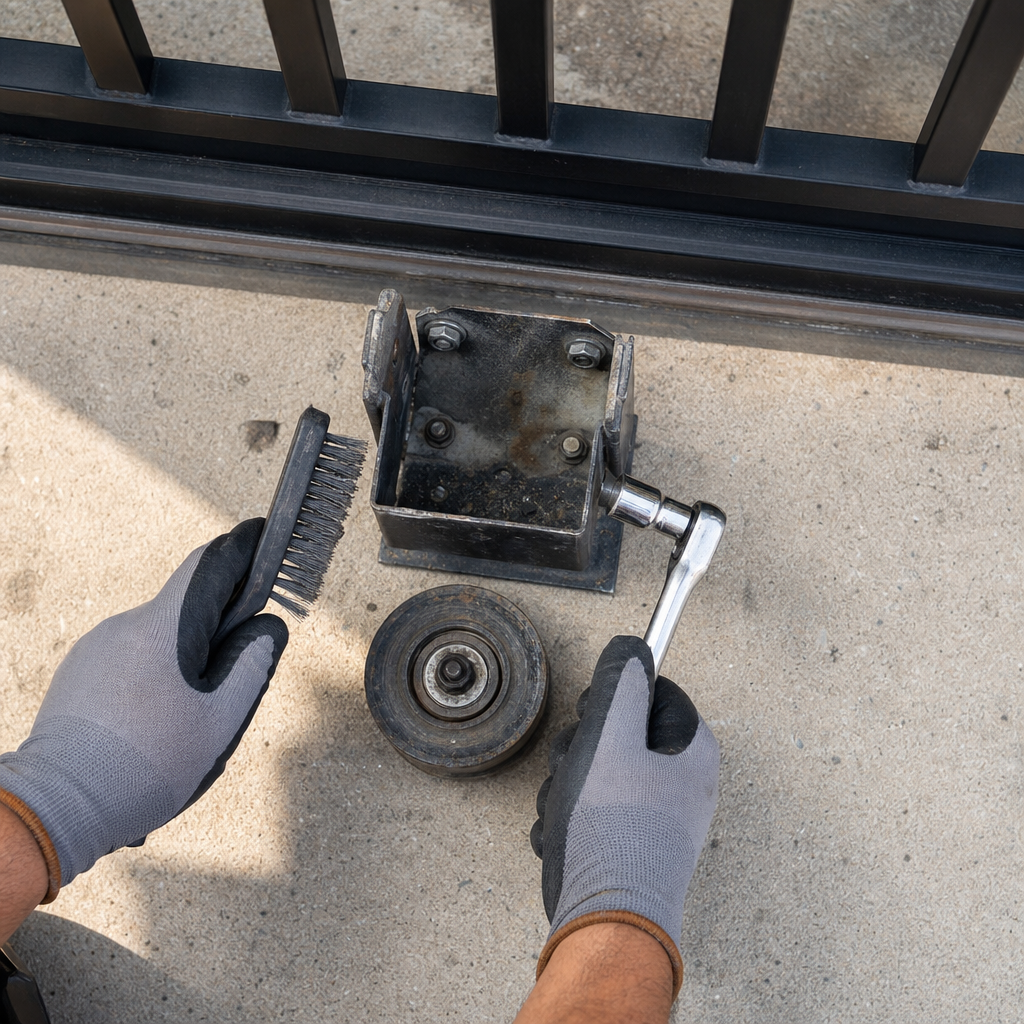
Never attempt to service a sliding driveway gate without proper support equipment. Large gate leaves can present serious crush and pinch hazards.
- Hydraulic bottle jack with an appropriate load rating for the gate
- Heavy-duty mechanical jack stands rated for the gate weight
- C-clamps or locking guide clamps to secure the top frame
- Metric and standard socket set with an impact driver
- Penetrating oil and anti-seize lubricant
- High-tensile replacement axle bolts and nylon-insert locknuts
- Stiff wire brush and angle grinder with a wire wheel for track cleanup
Step-by-Step Sliding Gate Roller Replacement Guide
Need sliding gate roller replacement?
We’re available now - call for a fast, free estimate.
Step 1: Disconnect Power and Release Drive Hardware
Turn off the electrical breaker feeding the gate operator and disconnect any battery backup units. Mechanically disengage the drive system by unlocking the manual release clutch or detaching drive hardware from the gate leaf. This allows you to roll the gate by hand, helping you detect track or alignment problems, jammed rollers, or debris blockage along the path of travel.
Step 2: Inspect the Ground Track and Foundation
Before lifting the gate, inspect the ground rail. Ground settlement or root growth can create high spots, dips, or track alignment problems that wear out rollers prematurely. Use a wire brush to remove debris blockage, dirt, pebbles, and rust scale along the rail. Check that all anchor hardware is flush with the footing so it does not catch the wheel housings.
Step 3: Lift and Secure the Gate Leaf
Place a hydraulic bottle jack under the solid bottom frame rail adjacent to the wheel box. As safety guidelines from Ironworks Gate Co. emphasize, never place a jack under decorative pickets or lightweight infill panels. Raise the gate leaf just enough to lift the roller clear of the track while keeping the top of the gate securely captured inside the upper guide hardware. Immediately slide a rated jack stand under the bottom beam and secure the top guide bracket with clamps to prevent tipping.
Step 4: Remove the Worn Roller Assembly
Loosen and remove the axle bolt holding the roller inside the wheel cavity. On older gates exposed to moisture, axle bolts can seize against the bearing sleeve. Apply penetrating fluid to the threads, allow it to soak, and back the bolt out. If hardware is completely seized, cut through the bolt shank using a reciprocating saw, taking care not to cut into the structural wheel housing or damaged casings.
Step 5: Clean and Prep the Wheel Housing
Clear away rust scale, dirt, and debris blockage packed inside the wheel cavity. Leaving debris inside the cavity limits clearance and can cause new rollers to jam. Clean the metal surfaces with a wire brush and apply a rust-inhibiting primer or cold galvanizing compound to bare steel before mounting the replacement hardware.
Step 6: Install New Heavy-Duty Rollers
Position the replacement wheel inside the housing, aligning the central axle sleeve with the bracket holes. Coat the replacement axle bolt with anti-seize compound and slide it through the assembly. Thread on a locknut and tighten it securely. Ensure you do not overtighten to the point where the housing walls bind against the wheel hub. Spin the wheel by hand to confirm it turns freely without jamming.
Step 7: Lower the Gate and Test Alignment
Repeat the replacement process for any remaining rollers on the gate. Once all wheels are installed, remove the safety stands and lower the hydraulic jack until the gate rests squarely on the ground track. Push the gate open and closed by hand to check for smooth travel and ensure there are no track or alignment problems.
Step 8: Reconnect the Drive System and Calibrate Limits
Reattach the drive system hardware according to Ironworks Gate Co. and manufacturer guidelines to avoid excessive drive strain or slack. Restore power to the operator, test full open and close cycles, and adjust the limit switches to ensure the gate stops smoothly at the intended travel limits.
Frequently Asked Questions
How much does it cost to replace sliding gate rollers?
As an approximate market estimate, professional replacement for standard sliding gate rollers typically runs between $120 and $400, including parts and labor. If the track is bent or requires alignment adjustments, overall repair costs can approximate $150 to $800 depending on the scope of work and site conditions.
Can I replace sliding driveway gate rollers myself or should I hire a pro?
While DIY replacement is possible for smaller installations, heavy gates present safety risks. Lifting heavy gate leaves requires properly rated jacks, stabilization to prevent tipping, and careful realignment. Hiring an experienced technician from a specialist like Ironworks Gate Co. ensures the work is done safely and that related issues like track alignment problems or damaged casings are addressed.
What size rollers do I need for my sliding gate track?
Roller size and profile depend on the specific track design, gate weight, and manufacturer specifications. Proper matching between the wheel groove and track profile is essential to prevent jamming and premature wear.
How long do heavy-duty sliding gate rollers typically last?
Roller gates are generally robust and highly reliable with rare documented failures. The operational lifespan of rollers depends heavily on environmental exposure, routine maintenance, bearing design, and whether the system is kept clear of debris blockage and track alignment problems.[1]
Why does my automatic gate stop halfway even after replacing the rollers?
If new rollers are installed but the gate still stops, check for track or alignment problems, debris blockage along the rail, broken cables, damaged casings, or operator force-setting limits that require adjustment.
Need sliding gate roller replacement?
We’re available now - call for a fast, free estimate.
Sources
- Chapter G-2 – usbr.gov
- [PDF] Risk Assessments for Gates Other Than Radial Gates – Reclamation – usbr.gov
- Chapter G-2 – Bureau of Reclamation – usbr.gov
- Dams Without Filters and Responding to Seepage Incidents – mtech.edu
- Literature Searches and Literature Reviews for Transportation … – libguides.northwestern.edu
Frequently Asked Questions
What type of replacement rollers are best for gates exposed to coastal salt air?
In coastal environments, standard carbon steel hardware degrades rapidly, making marine-grade stainless steel rollers with dual-sealed precision bearings the ideal choice. Ironworks Gate Co. specializes in installing corrosion-resistant wheel assemblies and structural load balancing to protect against premature seizing from salt air.
Why is operator limit recalibration necessary after sliding gate roller replacement?
New low-friction rollers significantly reduce mechanical drag, which alters the gate leaf momentum and travel speed across the track. Technicians from Ironworks Gate Co. recalibrate operator travel limits and internal force settings on the spot to prevent gate slamming or false safety reversals.
How quickly can seized sliding gate rollers be replaced in an emergency?
Property owners dealing with trapped vehicles or immobilized gates can access 24/7 live dispatch through Ironworks Gate Co. for same-day service. Our mobile specialists arrive fully equipped with high-capacity jacks, precision rollers, and track realignment tools to restore full operation immediately.
About the author
 |
Sarah Miller Sarah Miller is a specialized content writer focusing on property security and access control systems, with over six years of experience in the home services industry. Holding a B.A. in Communications from California State University, Fullerton, she translates complex technical repair processes and pricing structures into clear, actionable advice. Her work helps property owners navigate gate maintenance and repair costs, ensuring they make informed decisions when hiring contractors. |
Gate not opening, off track, or opener dead?
We’re available now - call for a fast, free estimate.
Call Now - Free Estimate