
Quick Summary
This emergency guide outlines the essential steps to open electric gate manually during power outages or system malfunctions by disconnecting power and disengaging the motor drive. Proper execution requires using the manufacturer release key to unlock the drive assembly and securing the gate leaf open, while contacting Ironworks Gate Co. for same-day diagnostic service if the gate binds or sits on a dangerous slope. Readers will learn how to safely restore emergency driveway access without damaging sensitive operator components or risking personal injury from uncontrolled gate movement.
Open Electric Gate Manually – Fast Emergency Steps
To open electric gate manually during a power outage or equipment failure, you need to cut electrical power to the unit, unlock the drive release mechanism, and physically disengage the motor from the gate panel. Once disengaged, you can move the gate leaf open by hand and secure it safely in place.
Never force a gate that binds or refuses to budge, as doing so can damage the operator or mounting hardware. Always follow the manufacturer’s manual release procedure for your gate model. Safety Disclaimer: Manual release methods differ by manufacturer and model. Consult your specific operator manual or a qualified technician, such as Ironworks Gate Co., if the gate binds, resists movement, or if the release mechanism is unknown.
Quick Guide: How to Open an Electric Gate Manually in an Emergency
Quick Guide: How to Open an Electric Gate Manually: Shut off power at the main breaker or operator switch. Follow the manufacturer’s manual release procedure for your gate model to disengage the drive mechanism, and slowly swing or slide the gate panel open. Always anchor the gate with wheel chocks or tie-downs so it cannot roll or swing freely.[1]
When an automatic gate will not open and traps a vehicle inside your driveway, properly releasing the operator lets you clear the opening without damaging the drive motor.
Key takeaways for stuck driveway gates
- Isolate power first: Turn off the subpanel breaker or motor power switch so the operator cannot activate unexpectedly while your hands are on the drive hardware.
- Disengage the drive: Follow the manufacturer’s manual release procedure for your gate model to free the gate leaf from the drive system.
- Control the leaf: Push the gate slowly from the main structural post, stop if you feel heavy friction, and tie or chock the panel open to prevent drift.
When to stop and call for emergency service
Stop immediately if the gate panel requires excessive force to push or if you hear metal grinding against the ground track. Heavy iron and wood gates can be exceptionally heavy. On sloping driveways, releasing a drive lock without proper physical control can let the gate run downhill uncontrollably. If the mechanical release is seized or the gate has dropped off its guide rollers, step away and call an experienced technician.[2]
What You Need Before Manually Overriding an Electric Driveway Gate
Keep a basic kit near the operator enclosure or in your garage so you are not hunting for tools during a blackout or storm. Having the right release tools on hand prevents broken keys and personal injury.
Essential tools and safety equipment
Gather these items before working on the gate operator:
- Manufacturer release key or tool: The specific key, handle, or tool supplied with your operator model.
- Heavy work gloves: Leather gloves protect your hands against sharp edges, pinch points, and hot motor casings.
- Wheel chocks or tie-down straps: Essential for blocking sliding gate wheels or strapping swing gates to an adjacent fence post to stop wind or gravity from moving the leaf.
- Penetrating lubricant: A quick spray of silicone or penetrating oil helps free access locks exposed to damp weather.
Identifying your operator type: sliding vs. swing gate
Sliding gates typically use a ground-mounted motor that pulls a chain or drives a gear rack along a track. Swing gates generally use an articulated arm, linear actuator, or hydraulic piston mounted directly to the gate post. Always identify your operator type and consult the manufacturer manual for the correct release process.
Step 1: Cut Electrical Power to the Gate Operator
Always isolate incoming electrical power before reaching inside an operator housing or touching drive components. If power suddenly returns or someone triggers an access control, the motor can start running without warning, presenting pinch and crush hazards.
Locating the dedicated breaker or master power switch
- Open the exterior disconnect switch or breaker box mounted next to the gate operator, if present.
- Turn off the dedicated gate circuit breaker located in your main electrical panel or subpanel.
- If your operator includes an active battery backup system, follow the manual’s instructions to disconnect battery power if required for safe servicing.
Preventing accidental motor startup during manual override
Cutting both electrical power and battery backup ensures the control board cannot energize the motor while you are working near moving parts, keeping the system in a safe state while you disengage the drive assembly.
Step 2: Locate and Unlock the Manual Release Mechanism
Need open electric gate manually?
We’re available now - call for a fast, free estimate.
The manual release mechanism is located on the operator body or the drive arm assembly. Refer to the manufacturer’s documentation for the exact release location on your specific unit.
Sliding Gate Releases
For sliding gates, locate the lock cylinder or access panel on the operator chassis as described in your operator manual. Unlock the panel to access the internal release lever, handle, or chain disconnect mechanism.[3]
Swing Gate Releases
For swing gate operators, the release mechanism may consist of a keyed access port, manual bypass control, or a disconnect pin on the mounting bracket. Consult your model manual before attempting to operate release valves or levers.
Step 3: Disengage the Motor Clutch or Disconnect the Drive Arm
Disengaging the drive separates the motor from the gate, allowing the leaf to move freely. Always follow the manufacturer’s manual release procedure for your gate model.
Using the release key, lever, or bypass mechanism
Follow the specific instructions in your operator manual to turn the release key, engage the cam lever, or adjust the bypass control. Do not force components if they do not turn smoothly.
Disconnecting mounting hardware if specified
If your manual instructs manual disconnection via a bracket pin, support the gate leaf to relieve mechanical pressure before carefully removing the pin and securing the disconnected arm.
Step 4: Manually Move the Gate Leaf Along the Track
With the drive system disengaged, you can move the gate panel by hand. Always push the gate slowly and evenly to keep it properly aligned.
Proper pushing technique to protect hinges and rollers
- Push from the frame: Place your hands directly on the main upright structural post. Never push or pull on decorative pickets or infill slats, as these components can bend or break under load.
- Walk the gate slowly: Walk the panel open at a slow, controlled speed to prevent excessive momentum from damaging end stops or guide rollers.
Checking for track obstructions and mechanical binding
If the gate binds or resists your push, do not force it. Check the ground track for dirt, gravel, or debris. For swing gates, verify that the bottom edge of the leaf is not dragging against the pavement.
Step 5: Secure the Gate in the Open Position to Prevent Drift
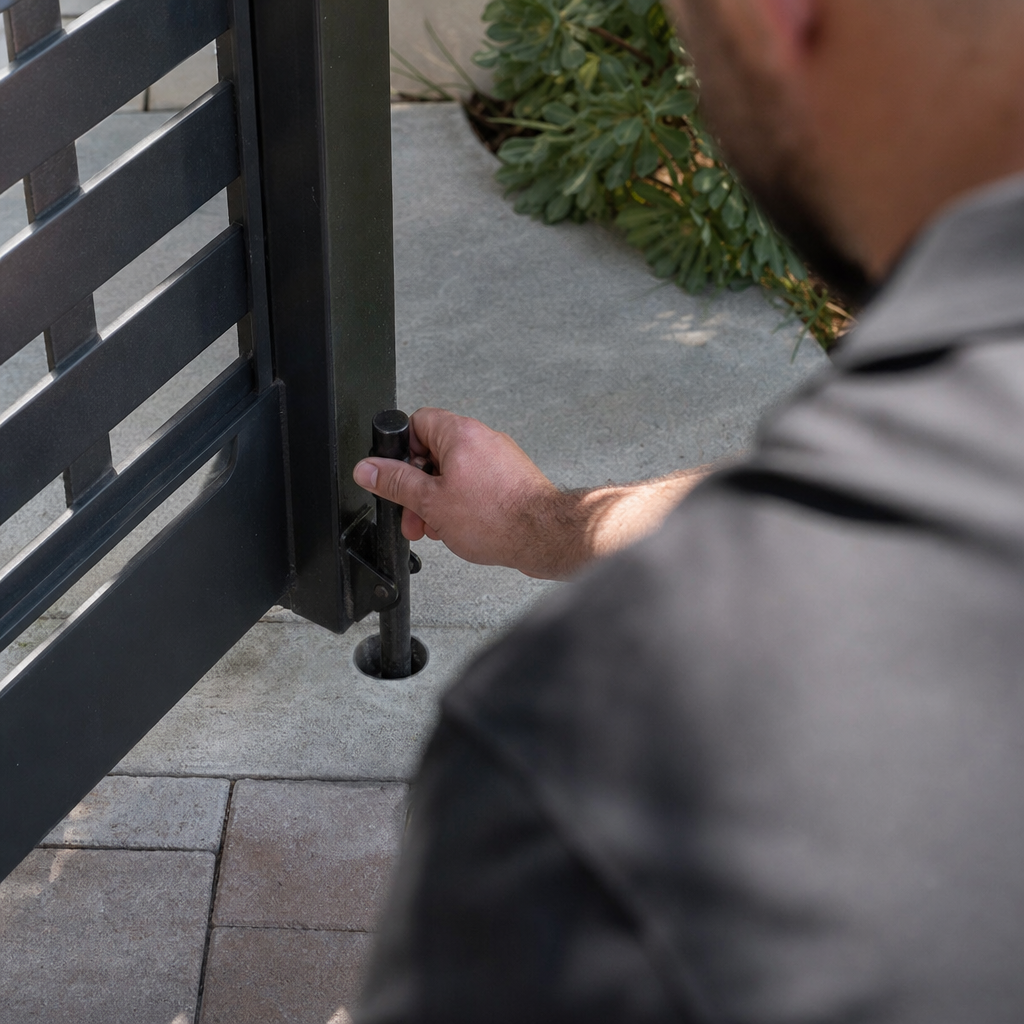
Once an automated gate is disconnected from its motor, it may move freely. Leaving an unlatched gate unattended creates a risk of wind moving the leaf into vehicles or pedestrians.
Mechanical chocking and securing methods
Place wheel chocks on both sides of the rollers on a sliding gate. For swing gates, secure the frame to an adjacent sturdy post or wall using a tie-down strap to keep the panel locked open against wind.
Preventing vehicle impact and sudden wind movement
Wind can catch wide gate panels and swing them shut unexpectedly. Securing the frame firmly in the open position ensures full driveway clearance until you are ready to re-engage the automatic operator.
Step 6: Reset and Re-Engage Automatic Drive Mode
When electrical power is restored or the mechanical fault is resolved, properly lock the drive system back into place before running the motor.
Locking the drive mechanism back into position
- Follow the manufacturer’s manual release procedure to reset the lever, bypass control, or disconnect pin back to the locked position.
- Gently test the gate by hand. When properly engaged, the gate should resist manual movement.
Restoring power and testing electronic limit sensors
Turn the circuit breaker or power switch back on. Clear all people, pets, and vehicles from the driveway path, then activate the operator. Observe a full cycle to confirm that travel limits, safety photo-eyes, and edge sensors operate correctly.
Hillside Hazards: Managing Gates on Slopes
Need open electric gate manually?
We’re available now - call for a fast, free estimate.
Operating a manual release on an uphill or downhill driveway introduces physical hazards. Disengaging a drive lock on a slope transfers the weight of the gate onto whatever is holding it back.
Gravity risks on sloped driveways
When an automated gate sits on an incline, gravity exerts force on the hardware. Disengaging the drive without securing the gate first can cause the panel to move downhill rapidly. Trying to catch or hold a heavy rolling gate by hand can cause severe injuries.
Safe handling on grades
Always block the gate securely with wheel chocks or straps to support the gate’s weight before opening the manual release. If you are unsure how to safely control a gate on a slope, contact a qualified technician like Ironworks Gate Co.
Common Components That Cause Gate Operators to Stop Working
If your gate suddenly stops responding to controls, the issue is often related to standard wear items or power interruptions.
Gate motor power and capacitors
A failed start capacitor, blown fuse, tripped breaker, or power supply issue can prevent the motor from operating when commanded.
Chain drives, rollers, and hinge binding
A loose drive chain, worn roller bearings, shifted ground track, or unlubricated hinge pins can increase friction, causing the operator to stall or halt travel.
Control boards and safety photo-eyes
Dirty or misaligned photo-eyes, moisture inside the control cabinet, or damaged wiring can prevent the gate from cycling normally as a built-in safety measure.
Gate Opener Manufacturers
Gate operator manufacturers – such as LiftMaster, DoorKing, Viking Access, Nice Apollo, FAAC, and BFT – utilize various release mechanisms across their product lines. Because specific override procedures, tools, and access points differ significantly between models, always refer to your specific operator manual for verified instructions.
What Does Electric Gate Repair and Service Cost?
Professional repair pricing depends on the nature of the mechanical or electrical issue, the gate operator design, and whether replacement parts are required.
Diagnostic, repair, and replacement considerations
A standard service call to diagnose an issue, clear a jammed release, realign safety sensors, or replace a capacitor varies based on local labor rates and parts. A qualified technician from Ironworks Gate Co. can inspect the track alignment, balance the gate weight, and provide a written estimate before performing repairs.
Frequently Asked Questions About Manual Gate Operation
Can forcing a gate open by hand damage the operator?
Yes. If you push a gate open without properly disengaging the manual release, you can damage internal drive components and housing. Always follow the manufacturer’s release steps before moving the gate.
What should I do if I lost the manual release key?
Do not attempt to pry open the operator housing. Consult your manufacturer manual for alternative access procedures or contact a professional gate technician who has the proper tools for your operator model.
Why won’t my gate work automatically after re-engaging the release?
Many operators need to complete a reset or calibration cycle after being moved manually. Ensure the manual release is fully returned to the locked position, power is restored, and safety sensors are clear of obstructions.
When should I call a professional gate technician?
You should call a technician if the gate drags, the operator fails to move under power, the manual release is seized, or the system repeatedly trips breakers. These symptoms indicate structural or mechanical issues that require professional evaluation.
Need open electric gate manually?
We’re available now - call for a fast, free estimate.
Sources
- DOCUMENT RESUME – files.eric.ed.gov
- Manual 402 – scribd.com
- How to Open Electric Gates Manually | Manual Override Guide – jfbmedia.com
Related reading: Sliding Gate Roller Replacement | Call Now-10% Off | Same-Day Service | Free Estimate
Related reading: How to Open Electric Gate Without Power | 10% Off & Free Estimate | Same-Day Service
Related reading: Reset Gate Motor | 10% Off & Free Estimate | Same-Day Service
Frequently Asked Questions
What should I do if the manual release mechanism is seized or won't turn?
If the key or release cam is frozen, apply a penetrating lubricant directly into the lock cylinder or pivot point and let it sit for several minutes before attempting to turn it again gently. Never use excessive force or pliers, as breaking the release key or internal linkage requires costly housing replacement. If it remains stuck, contact Ironworks Gate Co. for same-day service to safely disengage the operator without damaging internal gears.
Will manually opening my electric gate throw off its travel limit settings?
Most modern gate operators maintain their electronic limit memory, though some models may perform an initial slow calibration cycle once power and the drive are re-engaged. After locking the drive back into place, run one complete cycle from a remote or keypad to verify that the gate stops accurately at its open and close limits. If the gate overtravels or halts prematurely, Ironworks Gate Co. can recalibrate the magnetic sensors or limit switches.
Is it safe to leave an electric gate in manual mode for several days?
Leaving an electric gate disengaged for extended periods is not recommended because unsecured panels can easily catch wind gusts, stress the hinges, or derail from their tracks. Disconnected gates also compromise property security since they lack the motor's mechanical locking resistance. If your operator requires repairs or replacement parts, Ironworks Gate Co. provides 24/7 live dispatch to resolve the underlying failure and restore automatic operation quickly.
About the author
 |
Sarah Miller Sarah Miller is a specialized content writer focusing on property security and access control systems, with over six years of experience in the home services industry. Holding a B.A. in Communications from California State University, Fullerton, she translates complex technical repair processes and pricing structures into clear, actionable advice. Her work helps property owners navigate gate maintenance and repair costs, ensuring they make informed decisions when hiring contractors. |
Gate not opening, off track, or opener dead?
We’re available now - call for a fast, free estimate.
Call Now - Free Estimate