
Quick Summary
Improper sliding gate chain tension causes disruptive chain slap, track dragging, and severe motor strain, necessitating proper gate chain tension adjustment to ensure smooth operation. Drawing on decades of mechanical expertise, Ironworks Gate Co. advises maintaining roughly one inch of sag per ten feet of span using threaded tensioner bolts rather than pulling the chain completely rigid. Readers will learn how to safely inspect drivetrain components for wear and adjust tension brackets to prevent binding or schedule professional operator tuning.
Gate Chain Tension Adjustment: How to Check and Correct Excess Slack
Sliding gate drive chains require proper tensioning to operate smoothly. When a chain stretches or loses its set tension, excess slack can cause the chain to slap against the frame or drag. Conversely, overtightening the chain to eliminate all visible sag can cause binding and put unnecessary strain on the drive system.[2]
General engineering literature on heavy chain tension monitoring often focuses on industrial applications or water-control dam gates. These industrial tension percentages and dam-gate monitoring findings are not residential driveway-gate specifications. Residential operators must follow the specific manufacturer manual for proper calibration and setup.[1] See also Ironworks Gate Co Gate Repair Guide | Call Now-10% Off | On-Site in 60 Minutes | Free Estimate.
Driveway Gate Chain Tension Overview
Chain tension specifications vary significantly by operator manufacturer and gate model. Standard manufacturer guidelines recommend approximately 1 inch of sag per 10 feet for gate chain tension adjustment, but requirements vary by model. A chain should generally not be pulled completely rigid, but specialists at Ironworks Gate Co. note that installers and property owners must consult the applicable product manual rather than relying on a universal standard.[3]
Signs Your Sliding Gate Chain May Need Adjustment
- Chain slap: The chain clatters against the gate frame, bottom track, or operator housing during starts and stops.
- Chain sag: The chain sags low enough to drag along the ground or driveway surface.
- Operator strain or hesitation: The gate struggles or hesitates during travel due to binding or incorrect tension.
- Visible wear or misalignment: Drive components or chain links show uneven wear or alignment issues.
Safety Warning
Always prioritize safety when inspecting or servicing gate systems. Electrical work, damaged chains, structural gate problems, and uncertain diagnoses should be handled by a qualified gate technician from a team like Ironworks Gate Co. Do not attempt internal electrical repairs or work on heavily loaded components without proper training.[4]
Step-by-Step Slide Gate Chain Tension Adjustment
Need gate chain tension adjustment?
We’re available now - call for a fast, free estimate.
1. Disconnect Main Power
Always shut off power to the operator before touching the mechanical drivetrain to prevent accidental activation.
2. Disengage Drive and Test Manual Gate Travel
Use the manual release to disconnect the gate from the drive mechanism. Push the gate open and closed by hand to check for binding, track obstructions, or wheel issues. If the gate does not move freely manually, adjusting chain tension will not resolve the underlying mechanical problem.
3. Inspect the Chain and Mounting Hardware
Examine the entire length of the chain and tension brackets. Check for damaged links, severe corrosion, or worn hardware. If components are damaged, they should be replaced with compatible parts specified by the manufacturer.[5]
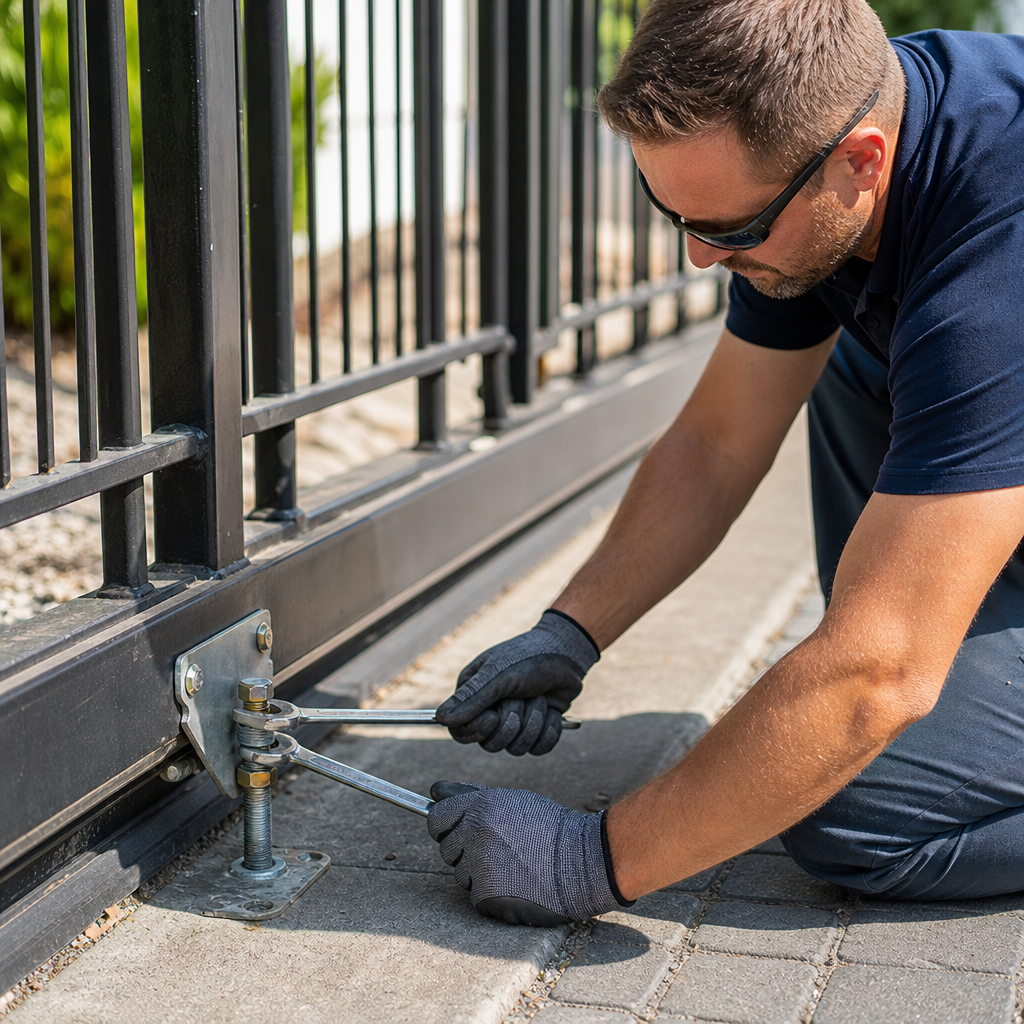
4. Adjust the Take-Up Nuts or Eye Bolts
Most slide gates use threaded tensioner bolts or eye bolts at each end of the gate:
- Loosen the locknuts on the tension brackets.
- Turn the adjustment nuts to achieve the manufacturer-recommended tension, taking care to avoid overtightening.
- Distribute adjustments evenly between the brackets to maintain proper alignment.
- Retighten the locknuts securely to keep the hardware in place.
5. Restore Power and Retest the Operator
Re-engage the manual release, restore electrical power, and run the operator through complete open and close cycles to confirm smooth operation.
Maintenance and Service Considerations
Routine inspection schedules, cleaning methods, and lubrication requirements should follow the specific operator manufacturer manual, as environmental conditions and equipment designs determine appropriate service intervals.
Frequently Asked Questions
How tight should a sliding gate chain be?
Certain manufacturer manuals suggest approximately 1 inch of sag per 10 feet for gate chain tension adjustment, though specs vary by model. Always consult your specific operator manual for the correct tension setting, and avoid pulling the chain completely rigid.
How do I tell if a problem is caused by chain binding or an electrical motor/capacitor fault?
If the chain is overtightened or physically obstructed, manual movement of the gate will typically feel stiff or bound. However, motor and capacitor faults require model-specific troubleshooting by a qualified technician.
Can I shorten my chain if the adjustment bolts have reached their limit?
Chain shortening or replacement should follow the manufacturer manual and use compatible parts. According to Ironworks Gate Co., if a chain has elongated significantly due to wear or damage, replacing the entire chain is often recommended.
Need gate chain tension adjustment?
We’re available now - call for a fast, free estimate.
Sources
- www.usbr.gov › ssle › damsafetyChapter G-1 – Bureau of Reclamation – usbr.gov (2019)
- Chapter G-1 – usbr.gov
- NTSB CAROL – my.ntsb.gov
- Self Excited Hoisting Chain Tension Measurements for Dam … – erdc.usace.army.mil (2026)
- ERDC Publication Notifications – Year 2026 – Page 10 – erdc.usace.army.mil (2026)
Related reading: Automatic Gate Won’t Open | 10% Off & Free Estimate | On-Site in 60 Minutes
Related reading: Emergency Manual Release Driveway Gate – 10% Off & Free Estimate – On-Site in 60 Minutes
Related reading: Reset Gate Motor After Power Outage | Call Now-10% Off | Same-Day Service | Free Estimate
Frequently Asked Questions
How can you tell if a sagging gate chain needs adjustment or full replacement?
If your chain has stretched past the limit of the take-up bolts or shows severe corrosion and loose roller pins, tightening will not solve the issue. Ironworks Gate Co. recommends checking the sprocket teeth for hooking, as excessive chain elongation requires a full replacement to protect the operator gearbox.
What mechanical damage can happen if a sliding gate chain is overtightened?
Pulling a chain completely rigid places severe radial strain on the operator drive shaft, motor bearings, and idler sprockets. This excess tension causes binding during startup, accelerated gear wear, and premature motor failure.
How often should you inspect and adjust sliding gate chain tension?
Driveway gate chain tension should be checked every six months, or quarterly in coastal areas where salt air accelerates metal fatigue and wear. Specialists at Ironworks Gate Co. suggest testing manual gate travel during each inspection to verify the chain maintains proper sag without binding.
About the author
 |
Sarah Miller Sarah Miller is a specialized content writer focusing on property security and access control systems, with over six years of experience in the home services industry. Holding a B.A. in Communications from California State University, Fullerton, she translates complex technical repair processes and pricing structures into clear, actionable advice. Her work helps property owners navigate gate maintenance and repair costs, ensuring they make informed decisions when hiring contractors. |
Gate not opening, off track, or opener dead?
We’re available now - call for a fast, free estimate.
Call Now - Free Estimate