
Quick Summary
Learning how to tighten sliding gate chain systems correctly is essential to resolve sagging and jerking without causing severe motor burnout or stripped drive sprockets. Ironworks Gate Co. outlines step-by-step procedures to disconnect power, adjust tension brackets evenly, and maintain manufacturer-specified slack to ensure smooth, damage-free operation. Readers will be able to perform safe chain tension adjustments or identify when severe elongation requires scheduling a professional gate assessment for replacement.
How to Tighten Sliding Gate Chain Without Motor Damage
When an automatic sliding gate starts jerking, clanking, or drooping, tightening the drive chain is often considered. However, chain slack is not a universal fixed measurement; the operator manufacturer’s specification always controls. Overtightening a sliding gate chain can increase wear on the chain, sprockets, and bearings.[3]
Roller chains require measurable, controlled slack to operate smoothly. Excessive tension can increase wear on the chain, sprockets, and bearings. Learning how to tighten sliding gate chain systems correctly, as noted by technicians at Ironworks Gate Co., means following manufacturer guidelines so the chain maintains proper slack and alignment.[1] See also Ironworks Gate Co Gate Repair Guide | Call Now-10% Off | On-Site in 60 Minutes | Free Estimate.
How to Tighten a Sliding Gate Chain: Quick Overview
To adjust a sliding gate chain safely, follow these fundamental rules:
- Follow manufacturer slack specifications: Chain slack is not a universal fixed measurement, and the operator manual specification controls. The chain must retain measurable, controlled slack. As general guidance, aim for approximately 4% of the sprocket center distance for a typical horizontal drive, and approximately 2% for vertical drives, center distances of at least 1 meter, heavy loads with frequent starts, or sudden reverse rotation.
- Disconnect power before adjustment: Always disconnect power to the operator and take steps to prevent gate operation before performing any adjustment work.
- Adjust brackets evenly: Turn the tension bolts on both ends in balanced increments so the chain stays properly aligned. Specific adjustment procedures may vary by model.
- Check alignment: The chain should remain parallel to the drive axis and should not drag on the ground, gate rollers, or idler frame.
Tools and Supplies You Need
Before making any adjustments, gather the necessary tools:
- Wrenches: Wrenches or an adjustable wrench set to hold the tension rod and turn the jam nuts. Fastener sizes vary, so verify the correct tool sizes in your specific operator manual.
- Measuring tape: To measure chain slack accurately.
- Cleaning brush and rag: To clean the threaded rods before adjustment.
- Chain lubricant: Inspect and lubricate according to the chain and operator manufacturer’s requirements.
Step 1: Disconnect Power and Secure the Gate
Disconnect power to the gate operator and ensure the system cannot operate while adjustments are being made.
Disconnecting electrical power ensures the gate cannot move unexpectedly during maintenance.
Step 2: Inspect Alignment and Measure Chain Slack
Inspect the chain path and evaluate slack according to manufacturer instructions.
- Measure the slack: Chain slack is not a universal measurement, and the operator manual controls. For a typical horizontal drive, general guidance recommends approximately 4% of the sprocket center distance (for example, approximately 32 mm of slack for an 800 mm span). Drives with vertical layouts, center distances of at least 1 meter, heavy loads with frequent starts, or sudden reverse rotation generally call for approximately 2% slack.
- Check chain alignment: Verify that the chain remains parallel to the drive axis and does not drag on the ground, gate rollers, or idler frame.
- Examine components: Inspect the chain and sprockets for signs of wear. Excessive tension can increase wear on the chain, sprockets, and bearings.
Step 3: Loosen the Jam Nuts
Need how to tighten sliding gate chain?
We’re available now - call for a fast, free estimate.
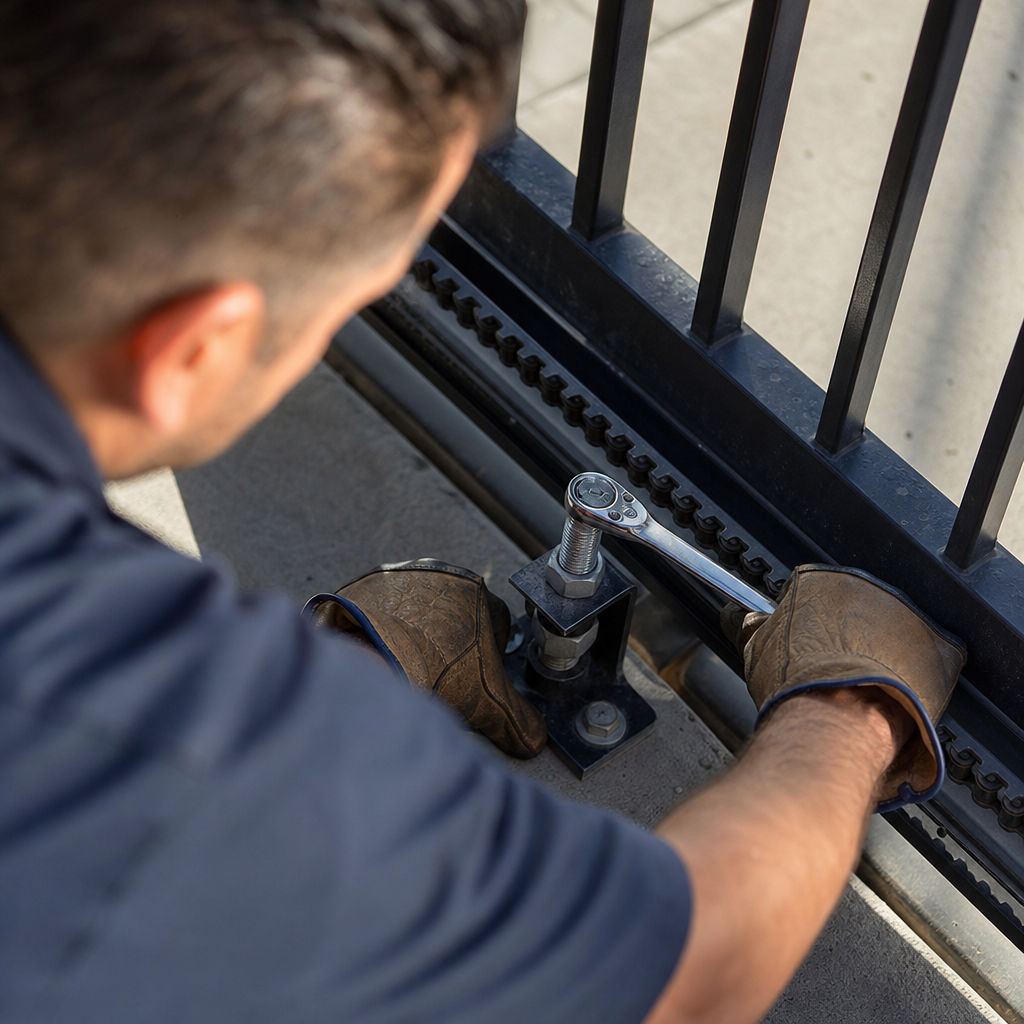
Specific hardware configurations depend on the operator model. For standard tensioner assemblies:
- Clean the threaded rods if needed.
- Hold the tension rod steady to prevent twisting.
- Loosen the locking jam nuts on the tension brackets.
Step 4: Adjust the Tension Bolts Evenly
Procedures can vary by model, so consult the operator manual or specialists at Ironworks Gate Co. for model-specific requirements.
- Adjust evenly: Adjust the tension bolts evenly on both brackets in small, balanced increments.
- Verify specified slack and alignment: Check that the chain achieves the specified slack and remains parallel to the drive axis without dragging on the ground, gate rollers, or idler frame.
Step 5: Secure Jam Nuts and Inspect the Chain
Once the specified slack and alignment are verified, securely tighten the locking jam nuts against the brackets.
Perform a thorough physical inspection:
- Adequate slack: Confirm the chain retains the specified slack.
- Proper alignment and clearance: Confirm the chain remains parallel to the drive axis and does not drag on the ground, gate rollers, or idler frame.
- Chain condition: Check the chain for kinks, stiff links, and proper sprocket engagement.
- Lubrication: Inspect and lubricate according to the chain and operator manufacturer’s requirements.
Step 6: Restore Power and Test Operation
Restore power to the operator and test gate operation.
During testing, observe the drive system and check for adequate slack, lubrication, abnormal noise, vibration, kinks, stiff links, and proper sprocket engagement. If excessive tension is present, it can increase wear on the chain, sprockets, and bearings.[4]
Chain and Sprocket Guidelines: Repair vs. Replace
Over time, regular wear between the internal pins and bushings causes chain elongation.
According to Ironworks Gate Co., a chain that cannot maintain the specified slack may be sufficiently worn or elongated and should be replaced rather than tightened further.[5]
Frequently Asked Questions About Sliding Gate Chain Tension
How tight should a sliding gate chain be?
Chain slack is not a universal fixed measurement; the operator manufacturer’s specification controls. As general guidance, horizontal drives typically require approximately 4% of the sprocket center distance in slack (such as approximately 32 mm for an 800 mm span). Vertical drives, center distances of 1 meter or more, heavy loads with frequent starts, or sudden reverse rotation typically require approximately 2% slack.[2]
What happens if a sliding gate chain is too tight?
Excessive tension can increase wear on the chain, sprockets, and bearings.
What causes a sliding gate chain to sag over time?
Chain elongation occurs primarily as wear develops between the chain pins and bushings over time.
Can I remove a link to shorten a loose gate chain?
A chain that cannot maintain specified slack may be sufficiently worn or elongated and should be replaced rather than tightened further.
Need how to tighten sliding gate chain?
We’re available now - call for a fast, free estimate.
Sources
- Top 5 Tips for Roller Chain Maintenance – Motion+Drives – motion-drives.com (2025)
- Installation & Maintenance Guide – catalog.ustsubaki.com
- The Complete Guide to Chain – catalog.ustsubaki.com
- Roller Chain General Catalog – U.S. Tsubaki – catalog.ustsubaki.com
- Installation & Maintenance Guide – catalog.ustsubaki.com
Related reading: Gate Chain Tension Adjustment – 10% Off & Free Estimate – Same-Day Service
Related reading: Emergency Manual Release Driveway Gate – 10% Off & Free Estimate – On-Site in 60 Minutes
Related reading: Reset Gate Motor After Power Outage | Call Now-10% Off | Same-Day Service | Free Estimate
Frequently Asked Questions
How often should sliding gate chain tension be inspected?
Drive chain tension and alignment should be inspected every three to six months as part of standard preventive maintenance. If your gate develops unusual noises, rattling, or visible drooping between service intervals, schedule a free on-site assessment with Ironworks Gate Co. to prevent motor strain.
What should you do if the chain tension bolts are fully tightened but the chain still sags?
When tensioner bolts reach their maximum adjustment limit, the roller chain has suffered excessive elongation from internal pin and bushing wear. Removing links on an over-stretched chain creates uneven pitch and damages sprockets, so you should contact Ironworks Gate Co. to replace the chain.
What is the best lubricant to apply after tightening a sliding gate chain?
Apply a dedicated, non-tacky roller chain lubricant or high-grade silicone spray that penetrates internal link pins without attracting grit and sand. Avoid standard grease or WD-40, as sticky residues trap abrasive outdoor debris that accelerates chain and sprocket wear.
About the author
 |
Sarah Miller Sarah Miller is a specialized content writer focusing on property security and access control systems, with over six years of experience in the home services industry. Holding a B.A. in Communications from California State University, Fullerton, she translates complex technical repair processes and pricing structures into clear, actionable advice. Her work helps property owners navigate gate maintenance and repair costs, ensuring they make informed decisions when hiring contractors. |
Gate not opening, off track, or opener dead?
We’re available now - call for a fast, free estimate.
Call Now - Free Estimate